The Agent is not a model that runs work
Most contemporary agent systems are organized around a trajectory. A model interprets a request, carries or reconstructs context, selects tools, delegates parts of the work, changes its plan, and eventually reports completion. The harness may preserve that trajectory for days; the system may add memory, graph execution, sandboxes, approvals, evaluators, and thousands of workers. These are substantial engineering advances, but they leave one question unresolved: where does the meaning of the work live when the model that currently interprets it is wrong, replaced, paused, or gone? My thesis is that the next generation requires a different architectural center.
The architectural center must move from the trajectory of a model to a persistent semantic system of delegated commitments, structured work, knowledge, memory, responsibility, authority, and evidence. Models reason inside that system. They do not constitute it. I use Persistent Semantic Agency for this position. The term does not describe a larger prompt, a durable chat session, or a coordinator that remembers more. It describes agency whose continuity is carried by explicit and governed semantic state: the system can preserve what it has accepted responsibility for, why current Decisions remain effective, which assumptions support them, what authority exists, what evidence has been obtained, and what still prevents closure.
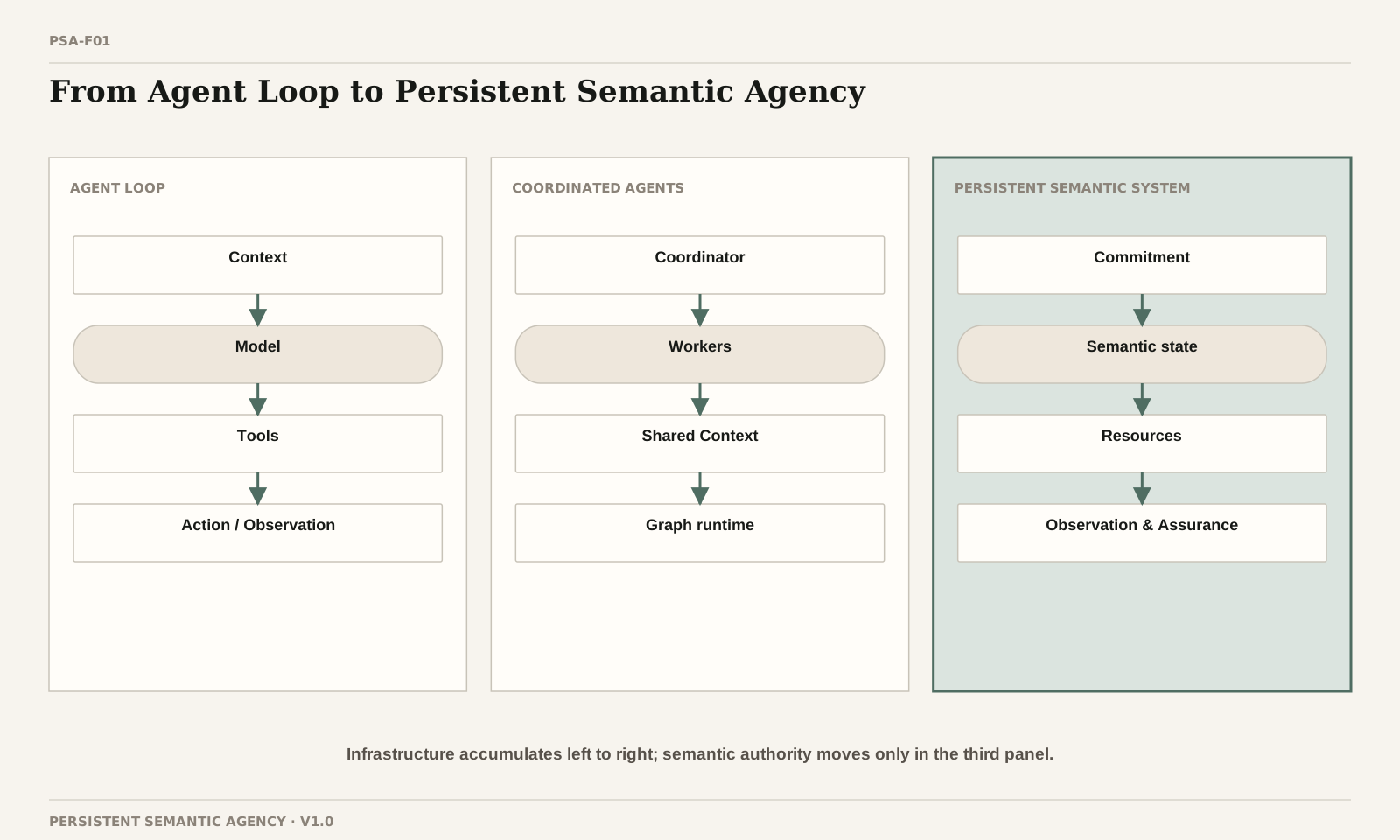
The architecture should survive the model
A current agent can be summarized, with increasing sophistication, as:
model
+ instructions
+ context
+ tools
+ loop
+ subagents
+ durable runtimePersistent Semantic Agency puts another substrate underneath and around that machinery:
Commitments
+ semantic Work IR
+ explicit knowledge and uncertainty
+ governed Memory
+ Responsibility and DelegationContracts
+ scoped Authority
+ independent Observation
+ Evidence, Verification, Acceptance, and ClosureModels remain essential because some work genuinely requires interpretation, research, modeling, design, critique, synthesis, or creation. The difference is that they become replaceable cognitive Resources rather than the place where the whole system's current meaning exists. A frontier model, a smaller local model, a human expert, a solver, a compiler, or an external organization may contribute to one responsibility; the accepted semantic state survives all of them. This inversion changes more than storage. It changes who may define work, how responsibility is delegated, what counts as current knowledge, when an effect is considered real, and who is allowed to decide that something is complete.
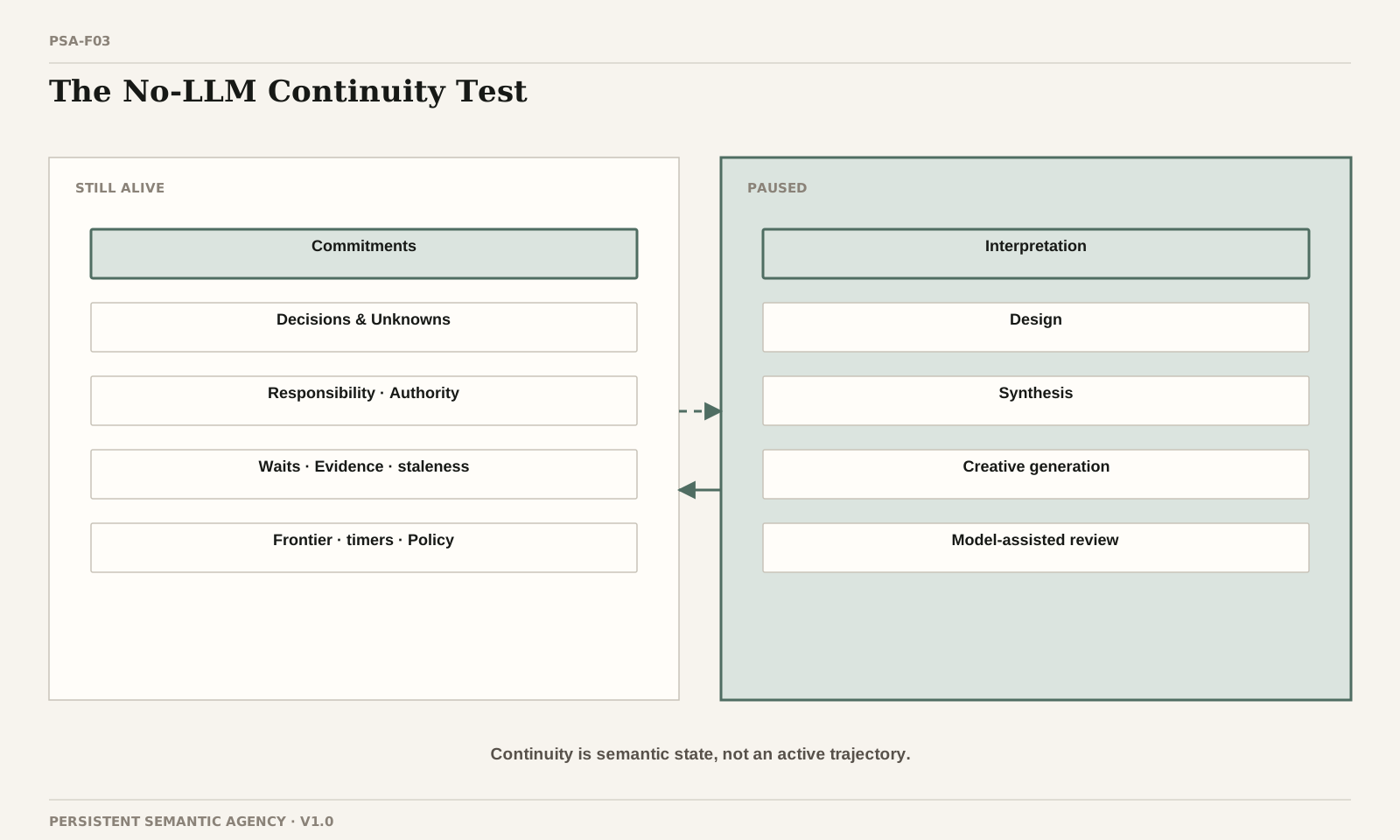
The no-LLM continuity test
The cleanest boundary is operational:
If every LLM inference process stops, the system must still know what it is responsible for, what is known and unknown, which Decisions are effective, which assumptions support them, who owns responsibility, what Authority exists, what it is waiting for, which Evidence exists, what became stale, and which semantic transitions are currently possible. A system that fails this test may still be an excellent agent runtime. Its continuity, however, is still constituted by model activity: recovery means reconstructing what a model thought the work meant. A persistent semantic system can wait without thinking, observe without improvising, derive readiness without asking a planner to reinterpret the whole project, and preserve an Obligation while no model is running.
Seven claims define the proposed system
Commitment carries long-lived agency
A Goal describes a desired state; a Commitment records responsibility that has actually been accepted; Authority limits the actions available while that responsibility is being fulfilled.
Goal ≠ Commitment ≠ AuthorityPlanning theory already gives strong reasons to treat intentions as relatively stable structures that coordinate action across time rather than as preferences reconsidered on every turn.[1]Philosophy of action, intention, and planning agencysourceOpen bibliography entry → Commitment-oriented multi-agent research provides another precedent by formalizing directed social commitments, activation, satisfaction, release, and violation.[2]Social commitments, interaction, and delegationsourceOpen bibliography entry → The proposal here is to make Commitment the continuity unit of a universal system, connecting user-facing responsibility to work, observation, authority, evidence, maintenance, and closure.
Work becomes durable semantics
The system needs a typed semantic Work Intermediate Representation (Work IR). The generic phrase is not claimed as unique: workflow, software, and AI-work systems already use intermediate representations for compilation and execution. Here, Work IR is the persistent, versioned representation of delegated work and its lineage. It owns accepted work semantics—Commitments, Outcomes, WorkNodes, Decomposition, Dependencies, Unknowns, Decisions, and Closure conditions—and carries typed relations to the other scoped semantic authorities that govern epistemics, Memory, Responsibility, Authority, Evidence, Domain Models, and Provenance. It integrates those domains without absorbing their ownership or admission rules. Any work may enter this representation. When work is not executable, the reason becomes explicit: the system may need to observe current state, research an Unknown, construct a model, obtain a Decision, wait for an event, or define a finite Horizon inside an open-ended Commitment. Hierarchical planning, systems engineering, and Work Breakdown Structures already establish important parts of recursive refinement.[3]Hierarchical, partial-order, and systems planningsourceOpen bibliography entry →[4]Hierarchical, partial-order, and systems planningsourceOpen bibliography entry →[5]Hierarchical, partial-order, and systems planningsourceOpen bibliography entry → The stronger position is that accepted work semantics and their lineage belong to the system, not to the private interpretation of whichever planner is active.
Delegation transfers responsibility
A prompt can ask another model to do something; it cannot, by itself, preserve purpose, authority, accountability, evidence requirements, escalation, or the boundary beyond which the recipient must stop. A proper DelegationContract therefore specifies the responsibility, expected outcome, relevant context, allowed capabilities, budget, evidence, acceptance, and redelegation rights. The receiving Resource can accept, decline, or challenge that contract. Contract Net and commitment protocols are direct precedents for explicit contracting and social coordination.[6]Social commitments, interaction, and delegationsourceOpen bibliography entry → Persistent Semantic Agency generalizes the idea across models, humans, deterministic systems, organizations, data boundaries, and verification, while keeping the Responsibility Graph independent of both the Work decomposition and the runtime topology of agents.
Memory, knowledge, state, and context remain separate
Memory is retained experience. Knowledge is what the system currently treats as justified under source, provenance, scope, Authority, confidence, and freshness. State records what has been accepted about work and responsibility. Context is a temporary, purpose-bound compilation for one cognitive or execution activity.
Memory ≠ Knowledge ≠ State ≠ ContextThis separation permits selective encoding, consolidation, revision, forgetting, contradiction-aware retrieval, and purpose-bound UserModelSlices. More importantly, it prevents a recalled episode, an old observation, or a semantically similar personal detail from silently becoming current truth merely because it was retrieved.
System intelligence maintains structure
Domain reasoning asks which architecture is sound, which market inference is justified, or which itinerary best fits a user's constraints. System or Structural Intelligence asks another class of questions: what supports a Decision, which work depends on an invalidated Assumption, which Resources are eligible, what belongs in a ContextPack, which transition is admissible now, and whether observed activity still conforms to accepted state. Truth Maintenance Systems established the value of preserving reasons for beliefs and revising dependent state when assumptions change; ATMS extended the idea to multiple conditional environments.[7]Truth maintenance, cognitive architectures, and metacognitionsourceOpen bibliography entry →[8]Truth maintenance, cognitive architectures, and metacognitionsourceOpen bibliography entry → The architecture proposed here applies related principles across Work, Responsibility, Authority, Evidence, and Closure, while preserving the distinction between epistemic weakness and the continuing normative force of an authorized Decision.
Reality is observed outside the executor
A successful tool response may not describe the resulting world state. A timed-out call may already have caused an external effect; a deployment report may say success while the service remains unhealthy; an artifact may exist without satisfying the parent Obligation. The architecture therefore preserves the full chain:
Result ≠ Observation ≠ Evidence ≠ Verification ≠ Acceptance ≠ ClosureThe distinctions are operational. They determine whether the system retries, reconciles, requests approval, reopens work, or closes a Commitment. A persuasive executor is still only one source of claims about what happened.
Learning improves procedure, never Authority
Experience can produce candidates for better decomposition, Resource selection, Context compilation, delegation, recovery, or verification. Durable learning requires evaluation, admission, versioning, monitoring, and rollback, because one successful trajectory is not sufficient evidence for a general Procedure. One ceiling remains absolute: the system may learn how to perform authorized work better; it may not learn that it has more Authority. Repeated approval, observed convenience, or user habit cannot manufacture a new permission.
The contribution is the change of center
None of the individual ingredients is presented as an invention. Stable intention, hierarchical planning, truth maintenance, cognitive architectures, episodic and semantic memory, metacognition, distributed cognition, provenance, workflow patterns, capability security, social commitments, and process conformance all have substantial ancestry. Contemporary systems are also moving semantics outside a single model call. The 2026 Graph Engineering paper describes a shift from individual intelligence toward System Intelligence through task, coordination, and runtime-state graphs.[9]Graph Engineering and agent operating systemssourceOpen bibliography entry → Workflow as Knowledge represents workflow definitions, instances, inference records, Context snapshots, and dependencies as persistent knowledge objects.[10]Semantic persistence and workflow/state representationssourceOpen bibliography entry → Closer semantic-IR, governed-memory, handoff, authorization, and agent-kernel precedents are examined with their primary sources in Chapter 11 — Graph Engineering and the Current Industry and Chapter 12 — Research Genealogy and Architectural Contribution. Their existence is part of the contribution boundary, not background that can be omitted. That evidence narrows the claim deliberately. I do not claim that persistent semantics, Work IR, semantic compilers, proposal/admission boundaries, or independent observation are individually new. I have not found, as of the stated research cutoff, a domain-independent agent architecture that places the complete combination of Commitment, semantic Work IR, epistemic support, governed Memory and User Models, independent Responsibility, compositional Authority, federated semantic admission, independent Observation, obligation-based Assurance, and derived Closure around one persistent center. This is a dated research finding, not proof of universal absence.
The proposed synthesis changes the center of gravity: the persistent object is not the agent trajectory, but a governed semantic system of delegated activity.
Boundaries keep the thesis testable
Persistent Semantic Agency may use planner models, graph runtimes, coordinators, agent operating systems, long-term memory stores, and domain compilers. It is not defined by any of them. If an implementation can still be faithfully described as one smart model owning the plan, selecting tools, forwarding prompts, adapting its private interpretation, and eventually declaring success, the architecture has drifted back to the current generation. The thesis remains distinct only while Commitments and accepted Work survive outside model context, Responsibility is not reduced to a subagent tree, external effects are independently observed, Closure remains outside the executor, and routine state evolution can continue with zero model calls.
Canonical system definition
Persistent Semantic Agency is the capacity of a governed system to preserve delegated commitments and explicit semantic work across time; dynamically assemble cognition and execution from models, humans, deterministic systems, knowledge sources, and external actors; act only within purpose-bound Authority; independently observe consequences; revise affected state through typed dependency and support relations; and derive Closure from Evidence rather than narrative assertion.
Reading the manifesto
The next chapters first explain why a durable agent loop remains the wrong center, then develop Commitment and Work IR, Memory and epistemics, Responsibility and Authority, cognitive Resource composition, System Intelligence, the logical architecture, governance, evolution, contemporary precedents, and the empirical tests that could weaken the proposal. The standard is not whether every mechanism survives implementation unchanged. It is whether the architecture is precise enough to build, criticize, compare, falsify, and improve.
Related chapters: Chapter 02 — The Agent Loop Is the Wrong Architectural Center · Chapter 03 — Commitments and Work IR · Chapter 08 — The Logical Architecture