Deliberation belongs inside the persistent system
Persistent Semantic Agency does not reduce the role of planning, reasoning, or creativity. It gives those activities an explicit place and prevents their temporary products from becoming the only representation of the work. The Deliberation and Cognitive Fabric covers intent interpretation, problem formulation, outcome and domain modeling, research, hypothesis generation, planning, design, constraint reasoning, simulation, counterfactual analysis, alternative generation, Decision analysis, synthesis, explanation, creative exploration, verification reasoning, and metacognition. These activities can determine the quality of everything that follows. They produce models, assessments, Artifacts, Evidence candidates, and ProposedSemanticChanges, sometimes at substantial cognitive cost. Their outputs still cross the same semantic boundary as human proposals, compiler results, and external observations: intelligence creates candidate structure; admission determines which part becomes accepted state. Planning remains a first-class operation without implying one permanent planning Actor:
Planning ≠ Planner AgentA frontier model, symbolic planner, constraint solver, DomainCompiler, search procedure, simulation, human expert, or hybrid composition may perform it. Hierarchical planning contributes recursive refinement, least-commitment planning contributes partial order and delayed choice, and systems engineering contributes architecture models, derived requirements, interfaces, failure modes, and verification planning.[1]Hierarchical, partial-order, and systems planningsourceOpen bibliography entry →[2]Hierarchical, partial-order, and systems planningsourceOpen bibliography entry →[3]Hierarchical, partial-order, and systems planningsourceOpen bibliography entry → The system can select among those methods because planning is represented as a responsibility and Procedure rather than embodied in a mandatory persona.
Reasoning effort follows semantic risk
The depth of a WorkNode does not predict how much intelligence it requires. A mission definition may contain broad uncertainty, while a small authorization transition, failure-state contract, or algorithm boundary may carry the larger blast radius. Reasoning allocation therefore depends on semantic uncertainty, impact, irreversibility, novelty, Evidence quality, verification strength, privacy, cost, and latency rather than on a simple distinction between strategic and mechanical work. Mission definition, product boundaries, architecture, ownership, security review, failure semantics, and verification design often justify strong Resources because errors at those points shape many descendants. Once the semantics are stable, compilers, generators, deterministic tools, or smaller specialist models can perform more of the transformation. A lower-level node can still receive stronger cognition when its uncertainty or consequences warrant it.
The strongest models should spend much of their capacity making later work cheaper, narrower, and easier to verify. A reasoning Budget can constrain tokens, time, money, external calls, human attention, or delegated descendants. It does not confer Authority. Additional cognition is an attributable allocation decision whose expected value can be evaluated against the Risk and the strength of later Verification.
Resource resolution composes more than models
A tool registry lists callable operations. A persistent Agent also needs a directory of cognitive, knowledge, observational, operational, and Assurance Resources.
| Resource class | Examples |
|---|---|
| Reasoning | frontier model, specialist model, local model, human expert |
| Deterministic computation | compiler, solver, calculator, static analyzer |
| Knowledge | database, documentation, web, governed Memory, human expert |
| Domain compilation | software, infrastructure, research, finance, operations compiler |
| Execution | coding executor, browser worker, script, organization, physical Actor |
| Observation | Git, CI, calendar, monitoring, sensors, authoritative APIs |
| Assurance | deterministic verifier, reviewer, auditor, Acceptance authority |
A ResourceProfile preserves the properties that matter for selection: Capability, expertise, Source and tool access, Authority compatibility, reliability, cost, latency, capacity, privacy suitability, location, independence, and historical performance. Those properties remain typed by responsibility. One model may be reliable for code generation and weak for architecture Verification; a human may hold the only valid Decision authority while being unavailable; a solver may be exact inside a formal model whose assumptions are themselves incomplete.
The Resource Resolver selects or composes mechanisms that can fulfill an accepted responsibility under Authority, Evidence, budget, privacy, availability, and independence constraints. A generator may be the right Resource for bindings, a compiler or language server for a semantic rename, two independent researchers for contested Evidence, a bank for current balance, and a human for a Decision outside the Agent's Authority. The selection objective is the quality of the resulting cognitive and execution system, not the universal competence of one model.
Temporary cognitive systems are the unit of composition
Some responsibilities should be assigned to several Resources by design:
independent research A
+ independent research B
→ synthesis
→ human Decisionconstraint solver
+ DomainModel
+ specialist model
→ feasible design alternativesimplementation Resource
→ independent Observation
→ deterministic tests
→ semantic review
→ AcceptanceA ResourceComposition records participants, Roles, information boundaries, aggregation, disagreement handling, and Closure policy. The composition can change from one responsibility to the next, which allows the architecture to use a single strong model where that is sufficient and a deliberately heterogeneous system where independence or complementary capabilities matter. Planner, Researcher, Operator, and Reviewer remain Roles that Resources may fulfill; they do not become a permanent cast of model personas. Independence is established through the composition rather than through process count. Two agents using the same model family, prompt, retrieved Evidence, upstream Source, and producer rationale may be highly correlated despite running separately. A verification composition can diversify model family, Source lineage, Context exposure, producer relationship, human organization, data origin, and execution environment. It may deliberately withhold the producer's persuasive narrative so that the verifier evaluates the Artifact and Obligations themselves.
External structure carries part of the intelligence
Human cognition already depends on documents, diagrams, instruments, institutions, calculators, databases, and other people. Hutchins' distributed-cognition research analyzes the functional system containing individuals and artifacts rather than reducing cognition to one mind.[4]Distributed cognition, external cognition, and transactive memorysourceOpen bibliography entry → The extended-mind thesis makes a related philosophical argument: external structures can participate in cognition when their coupling to the activity is sufficiently strong.[5]Distributed cognition, external cognition, and transactive memorysourceOpen bibliography entry → Work IR, Decision records, DomainModels, support relations, calculators, compilers, and Assurance systems serve the same architectural purpose. They preserve structure that a model would otherwise have to reconstruct whenever Context changes, and they make settled meaning available to several cognitive Resources at once. This is deliberate cognitive offloading, not compensation for one unusually weak model. Contemporary reviews likewise describe offloading as a choice shaped by expected effort, performance, and trust in the external aid.[7]Distributed cognition, external cognition, and transactive memorysourceOpen bibliography entry → Effective teams also distribute expertise and maintain a directory of who knows what. Research on transactive Memory describes that combination of specialized knowledge and shared awareness of its location.[6]Distributed cognition, external cognition, and transactive memorysourceOpen bibliography entry → A universal Agent needs an equivalent Knowledge Directory: which Source is authoritative for which claim, how fresh the information is, what access is required, how much it costs to obtain, and which Resource can interpret it. The system can therefore use knowledge without copying every Source into one Memory store.
Metacognition controls the next cognitive investment
Object-level cognition attempts to solve, model, research, design, decide, or generate. Meta-level monitoring estimates confidence, uncertainty, Evidence sufficiency, Source quality, contradiction, progress, remaining ambiguity, novelty, cost consumed, and the expected value of further work. Keeping these functions explicit allows the system to compare several next moves instead of relying on a prompt that tells the same Reasoner to “think more.” A MetacognitiveAssessment may lead to a CognitiveControlDecision that accepts the result, continues reasoning, retrieves more, observes the world, runs Research or an Experiment, changes Resource, introduces an independent critic, delegates, asks a human, or stops as inconclusive. Recent neuroscience treats metacognition as structured self-evaluation under uncertainty across several timescales, including uncertainty about confidence itself.[8]Truth maintenance, cognitive architectures, and metacognitionsourceOpen bibliography entry → Confidence therefore remains an assessment with provenance, method, and validity conditions; it never substitutes for Evidence. The control policy can spend more cognition on an irreversible Decision with weak Evidence and little verification capacity, while assigning a low-risk reversible transformation with strong deterministic checks to a cheaper Resource. No universal formula is assumed. The architectural requirement is that the decision to continue thinking, switch methods, or escalate remains explicit and attributable.
Determinism narrows the probabilistic surface
Many useful semantic transitions already have sufficient structure to run without a model. A Dependency closes and readiness changes; CI emits a fresh Observation; a deadline activates a Horizon; a Policy predicate denies a Capability; Evidence expires and Verification becomes stale; an external event wakes a Wait condition; a deterministic Closure rule becomes true. Invoking a model for those transitions would add cost and another opportunity for drift without adding semantic value. The same principle governs Semantic Work Refinement. A WorkNode may be refined by a rule, Procedure, solver, compiler, model, human, or ResourceComposition, producing Outcomes, Unknowns, Decisions, Dependencies, Obligations, domain targets, Responsibility needs, and verification expectations. Admission depends on the proposed revision and its Authority, support, and base state rather than on the prestige of the Reasoner. Stable mechanisms enforce structure the system already understands; models create new semantics where interpretation or judgment is actually required.
Exploration and human judgment remain native
Creative work often begins with an under-specified target, several alternatives, exploratory Artifacts, critique, aesthetic judgment, and human selection. The architecture can preserve material alternatives and accepted direction without pretending that every property was objectively knowable before exploration. The Materiality Boundary keeps local sketches and variations out of durable Work IR while retaining the Decisions and Artifacts that shaped the accepted result. Humans participate through the same semantic system. They may hold Decision, Approval, Judgment, ExpertReview, PhysicalAction, and Acceptance responsibilities, and the system can compile a decision package containing the question, alternatives, trade-offs, Evidence, recommendation when permitted, deadline, and impact. Human involvement is the correct Resource choice when Authority, accountability, physical action, or irreducible judgment belongs to a person.
Intelligence is distributed across the system
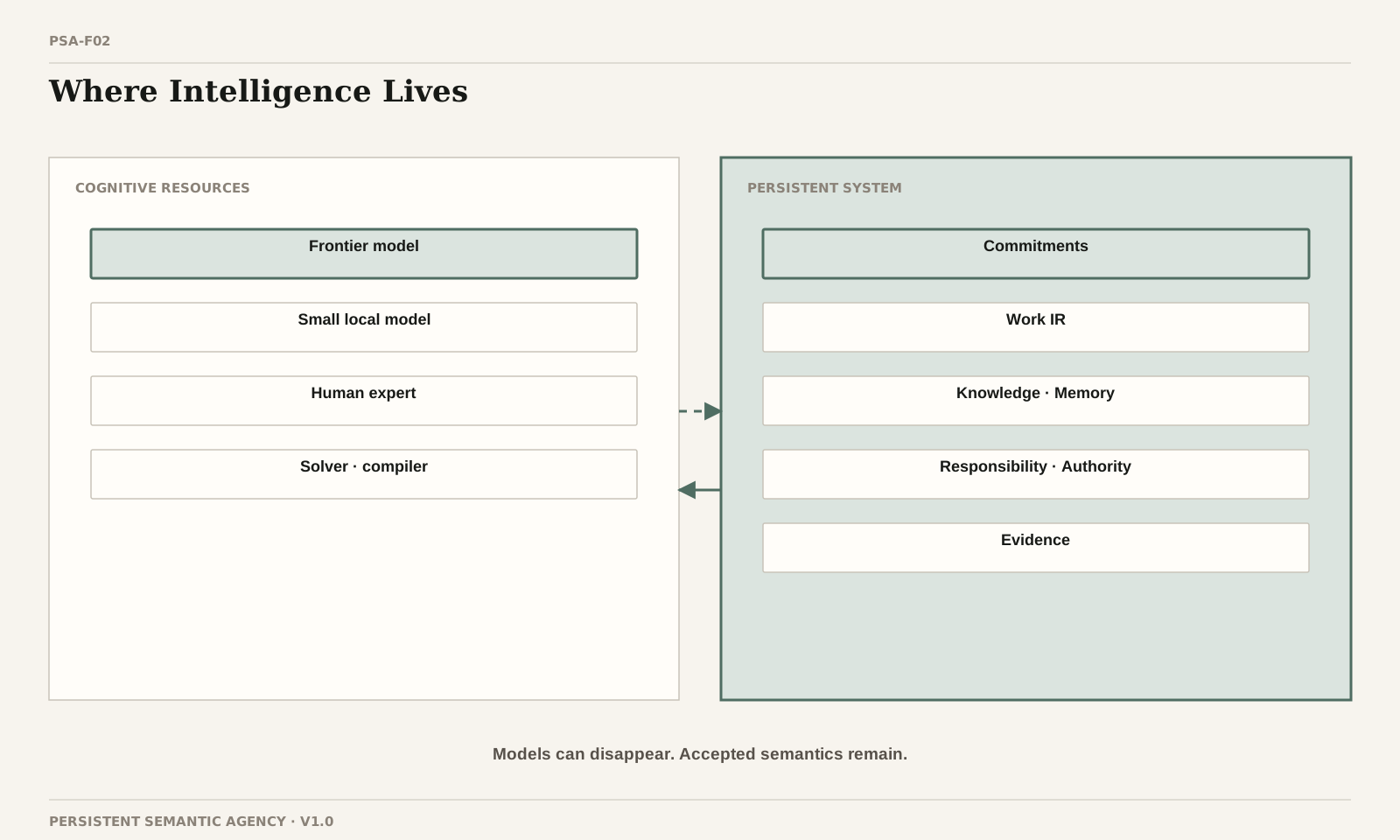
No component deserves the title of a single permanent “brain.” The architecture distributes cognitive responsibility:
semantic reasoning → models, humans, solvers
persistent thought → Work IR
intention and continuity → Commitment System
knowledge → Epistemic System + directories
Memory → Memory Fabric
working attention → Context Compiler
metacognition → assessment + control
coordination → Responsibility Graph
perception → Observation System
action → Capability + Execution Fabric
self-control → Governance
proof → Evidence + Assurance
learning → governed evolutionModels remain unusually powerful Resources because they can create new semantic structure across many domains. Their value increases when the rest of the system preserves, constrains, tests, and reuses that structure across time.