Responsibility begins with Commitment
A universal agent system needs more than goals and tasks because neither says whether the system has actually accepted responsibility. A Goal describes a desired state and may remain aspirational, exploratory, inactive, or weakly prioritized. A Commitment records responsibility that an Actor has accepted and must preserve across sessions, model changes, execution environments, and periods of inactivity. Authority defines what actions are permitted while that responsibility is being fulfilled.
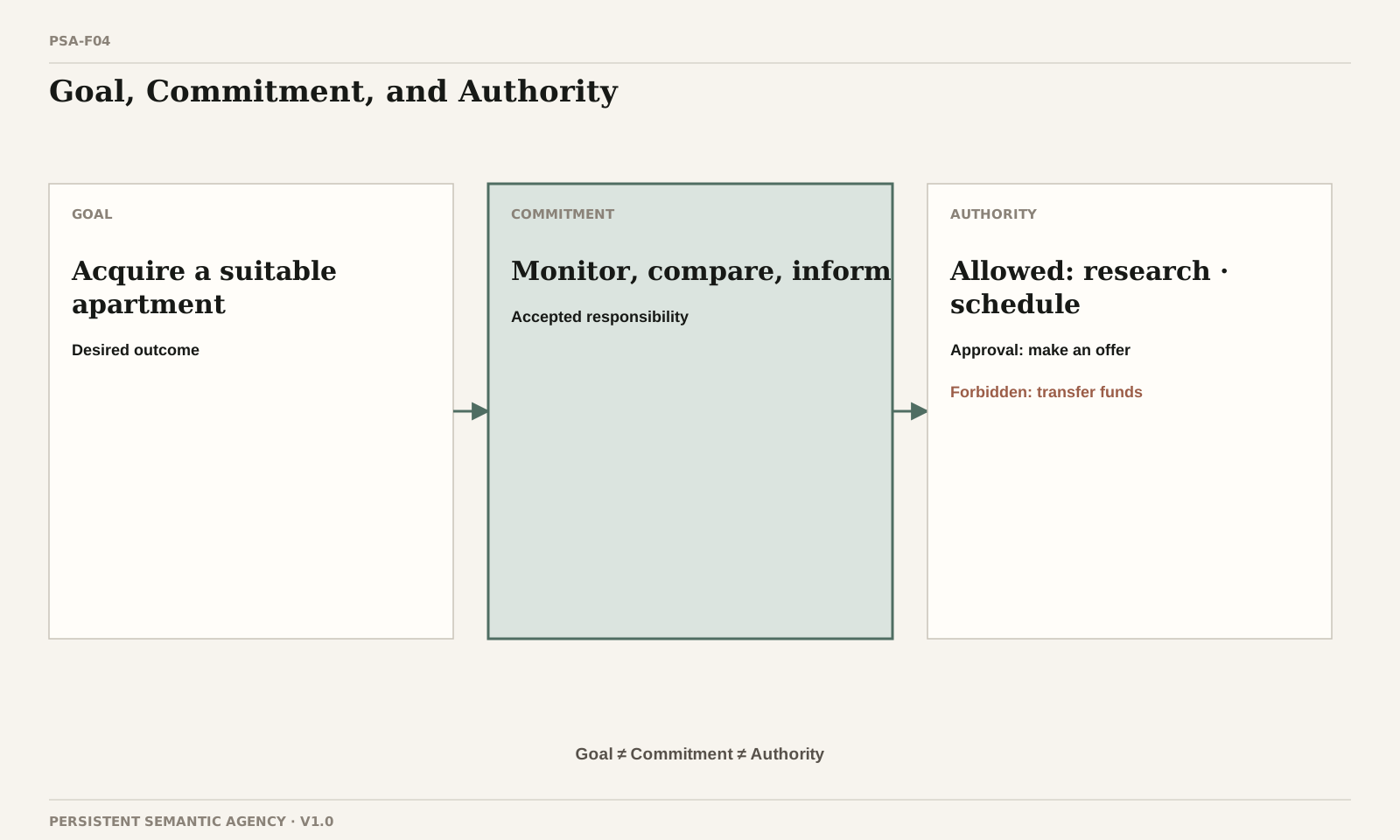
Goal ≠ Commitment ≠ AuthorityA user saying, “I may buy an apartment one day,” may establish a Goal or an area of interest without creating active work. “Monitor the market, compare suitable apartments, and keep me informed” is different: the system can accept an ongoing responsibility to observe and research, while Authority permits information gathering and perhaps scheduling viewings but forbids offers, signatures, or money transfers. This distinction has strong ancestry. Bratman's planning theory treats intentions and partial plans as relatively stable structures that coordinate behavior across time rather than as preferences reconsidered at every moment.[1]Philosophy of action, intention, and planning agencysourceOpen bibliography entry →[2]Philosophy of action, intention, and planning agencysourceOpen bibliography entry → Social-commitment research formalizes directed commitments among actors, including activation, satisfaction, release, and violation.[3]Social commitments, interaction, and delegationsourceOpen bibliography entry → The architectural proposal here extends these ideas into the continuity substrate of a universal system: Commitment becomes the root of activation, work, accountability, observation, and Closure.
A portfolio is not a queue
One Agent may simultaneously prepare a report, maintain a production service, monitor a flight, coordinate a launch, remember a renewal, investigate a scientific question, and manage an organizational obligation. These Commitments do not form one task queue because they differ in risk, deadline, activation state, resource demand, reversibility, and the kind of human attention they may require. A persistent Commitment Portfolio represents that set. A deliberately bounded Executive Control function allocates attention and Resources across it: work can be suspended, resumed, reprioritized, or escalated without silently changing what the underlying Commitment means. Executive Control decides where attention belongs; it does not become the hidden owner of every domain Decision.
Achievement, maintenance, and finite Horizons
An Achievement Commitment seeks to bring about a state: deliver a report, complete a migration, prepare a filing. A Maintenance Commitment seeks to keep a condition true while responsibility remains active: keep a service healthy, maintain calendar quality, or monitor a flight and react to disruption. Commitment research already distinguishes maintenance from one-time achievement.[4]Social commitments, interaction, and delegationsourceOpen bibliography entry → Maintenance cannot permanently close after one successful observation. Open-ended responsibility therefore advances through finite Horizons:
persistent Commitment
- current Horizon
- target
- Obligations
- Work
- Closure
- Observation policy
- next-Horizon policy
A Horizon may close while the parent Commitment remains active. This lets the system evaluate progress and proof without pretending that continuous responsibility has one final done state.
Work becomes a persistent intermediate representation
The central work object is a typed semantic Work Intermediate Representation (Work IR). The name is scoped by this definition; other systems use work, workflow, software, and semantic intermediate representations for narrower forms of compilation and execution. In this manifesto, Work IR is the durable representation of accepted delegated work and its revision lineage. It owns the work semantics themselves—Commitments, Outcomes, WorkNodes, Decompositions, Dependencies, Unknowns, Decisions, and Closure conditions—and links them to the scoped authorities that own epistemics, Memory, Responsibility, Authority, Evidence, Domain Models, and Provenance. Those domains participate in the work without becoming fields owned by one universal Work store. A useful minimum of objects that Work IR owns or references includes:
| Semantic family | Representative objects |
|---|---|
| Intent and outcomes | Intent, Goal, Commitment, Horizon, Outcome, Requirement, SuccessMeasure, Constraint, Policy |
| Knowledge and uncertainty | Observation, Fact, Inference, Assumption, Unknown, Hypothesis, Contradiction, Source |
| Reasoning and design | Model, Alternative, Decision, Rationale, Invariant, Contract, Risk, FailureMode |
| Work structure | WorkNode, Decomposition, Dependency, WorkPackage, Milestone |
| Governance | Actor, Role, ResponsibilityAssignment, AuthorityEnvelope, Budget, Approval |
| Execution | Execution, Attempt, Artifact, Effect, Blocker, ExternalWait |
| Assurance | Obligation, Evidence, Verification, AcceptanceDecision, ClosureDecision |
The canonical form of the work region is a typed graph with decomposition hierarchies and cross-cutting relations. A relational database, graph store, event log, or hybrid implementation may carry that form; physical storage may also be distributed across the scoped semantic authorities. Storage choice cannot redefine object meaning or transfer admission authority. Work IR remains authoritative for accepted work semantics, while Memory, epistemic state, Responsibility, Authority, Evidence, Domain Models, Provenance, and external reality retain their own ownership and freshness rules.
Any work may enter
The system should not reject work because it is vague, strategic, novel, large, or open-ended. The governing rule is:
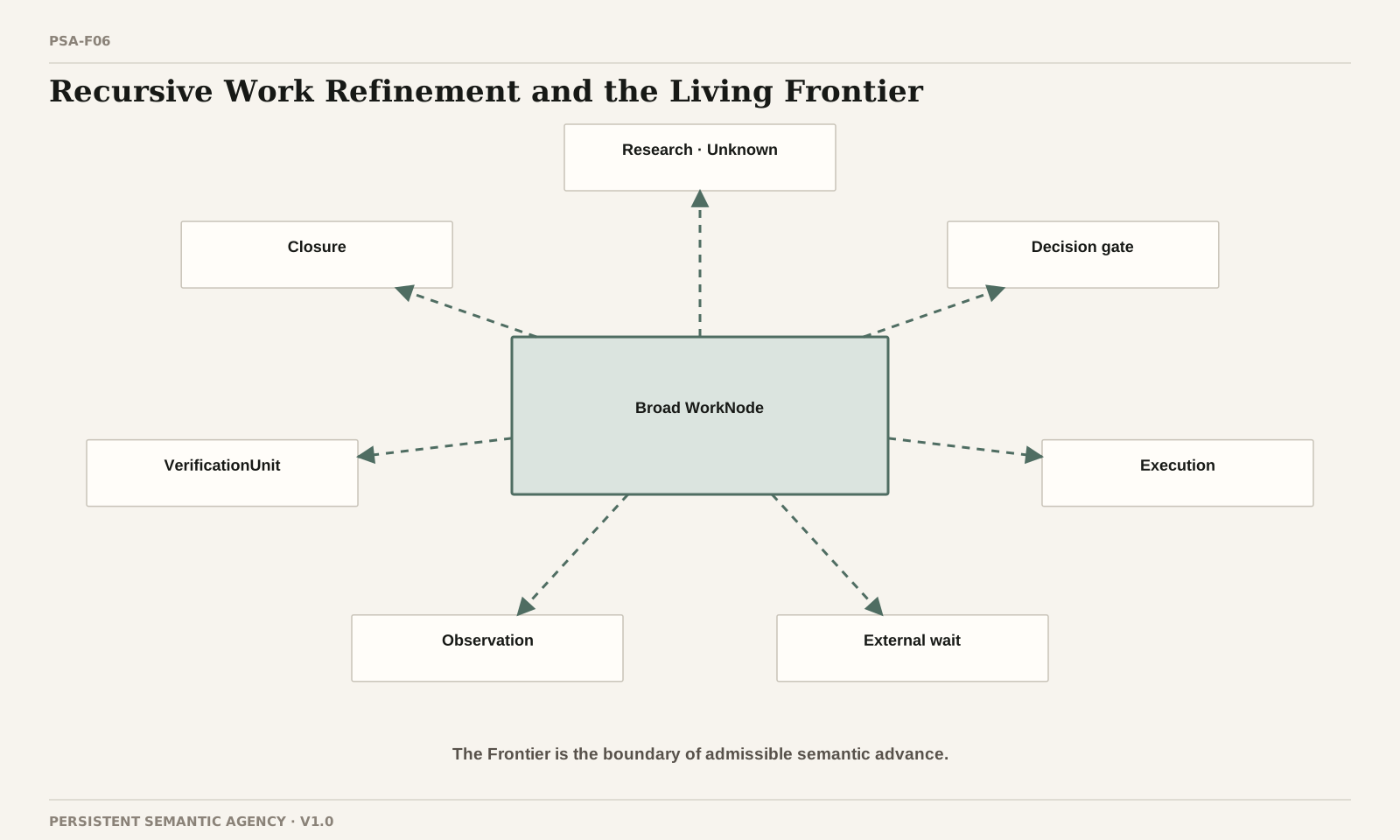
Every piece of work must either be executable now or refinable into work that makes a later state executable. When a WorkNode cannot progress, the reason becomes explicit work rather than hidden model uncertainty:
unknown current state → Observation or Research
unclear desired state → Modeling or Decision
multiple alternatives → Evaluation and Decision
insufficient evidence → Research or Experiment
external dependency → ExternalAction or Wait
insufficient Authority → Approval or Delegation
excessive uncertainty → deeper reasoning
excessive scope → DecompositionHierarchical Task Network planning established recursive refinement from compound tasks toward executable actions.[5]Hierarchical, partial-order, and systems planningsourceOpen bibliography entry → NASA's logical-decomposition process is explicitly recursive and iterative, connecting requirements, architecture models, interfaces, failure modes, derived requirements, Decisions, and rationale until design work becomes possible.[6]Hierarchical, partial-order, and systems planningsourceOpen bibliography entry → Work Breakdown Structure practice contributes hierarchical scope coverage and parent-child discipline.[7]Hierarchical, partial-order, and systems planningsourceOpen bibliography entry → The proposal differs in three material ways. Uncertainty reduction, modeling, and Decision work are normal executable work rather than preparation outside the system. The canonical representation is a typed graph rather than only a hierarchy. And the state remains live across cognition, execution, Observation, and Verification, so a discovery at one level can revise only the region that depends on it.
Semantic Work Refinement is resource-agnostic
Semantic Work Refinement makes a WorkNode more explicit. It may decompose, split, merge, or remove work; introduce Unknowns and Decisions; define Outcomes and Obligations; connect Dependencies; establish alternative SemanticContexts; materialize a domain target; propose Resource classes; or refine Closure conditions. No permanent Planner Agent is implied. A deterministic rule, Procedure, solver, DomainCompiler, model, human, or hybrid composition may perform the operation. The output is a proposed semantic revision that must pass the appropriate admission boundary before it becomes canonical. A broad request such as “Build production-grade notifications” can initially refine into lifecycle semantics, preferences, asynchronous delivery, user-visible state, recovery, and observability. The delivery region may introduce an Unknown about provider acknowledgement and a Decision about idempotency. Only after those semantics become explicit does a bounded implementation responsibility exist.
Unknowns and Impasses prevent improvisational drift
An Unknown is a materially relevant unresolved question. It preserves what is not known, why the answer matters, what is blocked, which source classes are acceptable, what would count as resolution, and which Evidence is required. It is not merely low confidence inside a model response. An Impasse is the runtime condition in which no valid path can currently advance. The cause may be missing knowledge, a required Decision, insufficient Authority, unavailable capability, contradictory Evidence, an external dependency, an infeasible target, failed Decomposition, or inconclusive Verification. Soar supplies an important precedent: insufficient knowledge to select or apply an operator creates an impasse and a substate dedicated to resolving it.[8]Truth maintenance, cognitive architectures, and metacognitionsourceOpen bibliography entry → The architecture generalizes that move across epistemics, Authority, Responsibility, and Assurance. An Impasse creates resolution work. It does not grant permission to guess around the missing condition.
Decisions survive the reasoner that proposed them
A material Decision preserves the problem, alternatives, selected option, Decision authority, rationale, Evidence, Assumptions, constraints, implications, affected Work, effective time, reconsideration policy, and revision lineage. A model may propose it; the required Authority and admission semantics determine whether it becomes effective. Decisions remain stable by default because long-lived work cannot reopen every architectural or organizational choice whenever a new model prefers another alternative. Reconsideration requires a legitimate trigger such as contradictory Evidence, an invalidated Assumption, a changed requirement, a crossed threshold, infeasibility, higher-authority change, or scheduled review. A fresh opinion is not a state transition. This stability is not resistance to learning. It is what makes revision explicit and attributable.
The Frontier is a derived boundary, not a scheduler queue
There is no global sequence in which the whole system plans, then executes, then verifies. At one moment, one region may be unexpanded, another under Research, another waiting for a HumanDecision, another delegated and executing, another verifying Evidence, another closed, and another stale because an Assumption changed. The Work Frontier is the derived set of semantically admissible and potentially useful transitions now:
resolve Unknown U
observe Source S
request Decision D
refine Work W
delegate Responsibility R
execute Transformation T
reverify Obligation O
reconsider Decision D
wait for Event EThe Frontier changes when accepted semantics change. It is not primary state and cannot be owned by a scheduler, because readiness depends on Decisions, Authority, Knowledge, Resources, time, Policy, and current SemanticContext rather than only on predecessor completion.
Partial order preserves options
Ordering should be introduced only when required by causal, informational, Authority, Resource, safety, or temporal dependency. Least-commitment planning established the value of preserving partial order and deferring choices that do not yet need to be made.[9]Hierarchical, partial-order, and systems planningsourceOpen bibliography entry → A complete global plan is therefore unnecessary. The local Frontier must be constrained enough to advance safely, while unrelated regions remain free to develop in parallel. This reduces premature coupling and makes local revision possible when the world changes.
Materiality keeps the system usable
Formal semantics should not capture every search, mouse click, retry, file open, local calculation, or intermediate thought. Executors may perform extensive local cognition and operations while a WorkNode remains one bounded responsibility. A change becomes a candidate for durable semantic state when it can materially affect a Commitment, Goal, Decision, Authority, Responsibility, Outcome, Obligation, future Work, Memory, Risk, Closure, or an irreversible external effect. The Materiality Boundary controls semantic density: it prevents Work IR from becoming an enormous trace while preserving the changes that matter for accountability, revision, security, and proof.
The Materiality Boundary is deliberately lossy. This architecture proposes a provenance-preserving retrospective promotion path rather than perfect foresight. Low-level activity may remain in bounded Execution or audit traces without becoming canonical Work. Event-abstraction and high-level-event-mining research show that retained low-level event data can support later higher-level interpretations, while W3C PROV supplies derivation, revision, and invalidation relations for preserving lineage.[10]Provenance, workflow semantics, and process conformancesourceOpen bibliography entry →[11]Provenance, workflow semantics, and process conformancesourceOpen bibliography entry →[12]Provenance, workflow semantics, and process conformancesourceOpen bibliography entry → A retained trace may therefore support a ProposedSemanticChange that creates an Observation, Contradiction, Evidence item, Unknown, or revision trigger. The trace does not promote itself: Source Authority, trace integrity, the applicable Policy context, support, and impact remain subject to ordinary scoped Admission. If the trace is absent or insufficient, the correct state is explicit uncertainty rather than reconstructed certainty. High-risk Modules may lower the threshold or retain supporting traces longer without turning every local action into Work IR.
Closure is derived from accepted state
Execution completion is not semantic completion. A typical finite WorkNode may close only when:
required Dependencies are satisfied
AND required children satisfy coverage rules
AND Obligations are verified or validly waived
AND required Decisions are effective
AND required approvals or Acceptance exist
AND no blocking Contradiction remains
AND Evidence is fresh enoughDecomposition coverage may be ALL_OF, ANY_OF, ONE_OF, K_OF_N, ADVISORY, or a typed Module predicate. The parent defines what its children mean for Closure; a successful child cannot promote itself into parent completion.
This is where the architecture becomes operationally different. The executor submits a Result, an Observer recovers actual state, a verifier evaluates Evidence against Obligations, and Closure follows from the accepted semantics that remain.
Work under Commitment is the persistent object
The inversion can now be stated precisely:
Current agent abstraction:
Agent owns plan, interpretation, next action, adaptation, and done.
Persistent semantic abstraction:
Work IR owns accepted work semantics and lineage.
Other scoped authorities own epistemics, Memory,
Responsibility, Authority, Evidence, Domain state, and Provenance.
Reasoners propose refinements.
Resources fulfill bounded responsibilities.
Observers recover actual state.
Verifiers evaluate Evidence against Obligations.
Closure is derived.The persistent object is work under Commitment, not the trajectory of the Actor currently reasoning about it.