Canonical formulation
Persistent Semantic Agency is the capacity of a governed system to preserve delegated commitments and explicit semantic work across time; dynamically assemble cognition and execution from models, humans, deterministic systems, knowledge sources, and external actors; act only within purpose-bound authority; independently observe consequences; revise affected state through typed dependency and support relations; and derive closure from evidence rather than narrative assertion.
Naming boundary
Persistent Semantic Agency is the canonical name of this architectural synthesis. The publication does not claim historical first use of the individual words persistent, semantic, or agency. Use PSA only where an abbreviation is useful. Do not use PSE: Persistent Semantic Entities is an existing ICML 2026 term for hidden semantic contamination that persists across tool-augmented LLM sessions and agent boundaries.[1]Semantic persistence and workflow/state representationssourceOpen bibliography entry → Likewise, Work IR is a scoped definition in this manifesto, not ownership of a generic phrase used by workflow and domain-specific systems.
Agency and continuity
Intent
An interpreted meaning behind a user act, external event, standing policy, or internal trigger. Intent may be ambiguous and does not automatically create durable responsibility.
Goal
A desired state or class of states. A Goal may be aspirational, exploratory, inactive, or subordinate. It does not imply responsibility, permission, budget, or immediate action.
Commitment
An accepted responsibility held by the Agent or another Actor for a Principal or beneficiary, with activation, satisfaction, authority, reconsideration, and termination semantics.
Achievement Commitment
A Commitment to bring about a state and satisfy it under an evidence policy.
Maintenance Commitment
A Commitment to maintain a condition while responsibility remains active. One successful observation does not permanently satisfy it.
Commitment Portfolio
The set of accepted Commitments, their state, priority, deadlines, dependencies, conflicts, resource demands, and reconsideration conditions.
Executive Control
The bounded system function that allocates attention, cognitive budget, scheduling priority, and scarce Resources across the Commitment Portfolio. It may suspend, resume, escalate, or request reprioritization without silently changing Commitment meaning or becoming the owner of domain Decisions. It consumes attributable projections and produces allocation decisions or proposals; it cannot directly rewrite domain Decisions, expand Authority, or determine Closure.
Horizon
A finite or evaluable frame inside an open-ended Commitment. A Horizon can close while its parent Commitment continues.
ActivationCondition
A time-, event-, state-, dependency-, manual-, or Policy-based condition that activates a Commitment, Horizon, or WorkNode. A scheduler may implement part of the mechanism, but the condition's meaning belongs to semantic state.
Outcome
A desired semantic result defining what should be true, not how it will be achieved.
Work semantics
Work IR
In this manifesto, Work IR means the persistent, typed, versioned semantic Work Intermediate Representation of accepted delegated work and its lineage. It owns work semantics such as Commitments, Outcomes, WorkNodes, Decompositions, Dependencies, Unknowns, Decisions, and Closure conditions, and carries typed relations to the scoped semantic authorities that own epistemics, Memory, Responsibility, Authority, Evidence, Domain Models, and Provenance. Work IR integrates those domains without replacing their separate ownership, freshness, and admission rules. The generic phrase is not claimed as unique; other systems use work or semantic IRs for workflow execution and domain compilation.
WorkNode
The universal recursive unit representing something that must be progressed, learned, modeled, decided, changed, produced, verified, approved, communicated, or waited for.
Semantic Work Refinement
A resource-agnostic operation that proposes more explicit work semantics: decomposition, merging, splitting, Unknowns, Decisions, Obligations, Dependencies, SemanticContexts, or domain targets.
Decomposition
A versioned relation that refines parent Work into children with rationale, coverage, dependencies, and created obligations or Unknowns.
Decomposition coverage
The semantic rule by which children contribute to parent closure: ALL_OF, ANY_OF, ONE_OF, K_OF_N, ADVISORY, or a typed custom predicate.
Dependency
A typed condition between semantic objects, including completion, data, decision, authority, resource, temporal, and external-state dependency.
Work Frontier
The derived set of semantically admissible and potentially useful transitions now. It is not a task queue and not primary state.
Unknown
A materially relevant unresolved question with scope, blockers, resolution criteria, acceptable source classes, and evidence requirements.
Impasse
A runtime inability to make valid progress due to missing knowledge, Decision, capability, authority, resource, external dependency, feasible target, decomposition, or conclusive verification.
Decision
An authoritative selection or establishment of course, interpretation, design, or policy, preserving alternatives, authority, rationale, evidence, assumptions, implications, and reconsideration conditions.
ReconsiderationPolicy
The legitimate triggers under which an effective Decision or long-lived Commitment may be reopened.
Materiality Boundary
The rule deciding which changes require durable semantic representation. Material changes affect Commitment, Goal, Decision, Authority, Responsibility, Outcome, Obligation, future Work, Memory, Risk, Closure, or consequential external effect. The boundary is deliberately lossy. Persistent Semantic Agency proposes a provenance-preserving retrospective promotion path rather than perfect foresight: retained bounded Execution or audit trace may support a ProposedSemanticChange, but it does not promote itself. Source Authority, trace integrity, applicable Policy context, support, and impact remain subject to ordinary Admission. Missing or insufficient trace produces explicit uncertainty, not reconstructed certainty.
Epistemics and support
Observation
A time-bound reading of an internal or external Source with subject, value, collector, occurrence time, observation time, integrity, scope, and freshness.
Fact
An accepted proposition under a defined authority, scope, validity interval, and epistemic policy. It is not metaphysically certain truth.
Inference
A proposition derived from identified inputs and method, with attributable reasoner and confidence.
Assumption
A proposition deliberately treated as true for specified reasoning despite insufficient evidence, with affected work and invalidation conditions.
Hypothesis
A testable proposition whose truth remains intentionally unresolved.
Contradiction
A material incompatibility among accepted or proposed claims. It remains explicit until resolved, scoped, or admitted as uncertainty.
Source
The origin of knowledge or observation, including identity, type, authority scope, access method, freshness, trust, and sensitivity.
Source Authority
The claim classes and scope for which a Source is authoritative. Authority is never global merely by source type.
Typed Support Relation
A relation explaining current justification, including epistemic support, assumption dependence, corroboration, normative authority, work dependency, or causal relation.
Validity
A typed status such as Epistemic, Normative, Authority, Temporal, Context, or Verification validity.
SemanticContext
A conditional environment in which semantic objects are valid: actual accepted state, assumption environment, forecast, design alternative, counterfactual, or experimental context.
Provenance
The history of generation, usage, derivation, attribution, activity, actor, source, and time. Provenance explains origin, not current validity by itself.
State, projection, and semantic change
Canonical state
Durable accepted semantic objects and revisions owned by their scoped authorities. Canonical state changes only through admitted transitions; it is distinct from caches, views, rankings, and model assessments.
Deterministic projection
A reproducible value derived from identified canonical revisions, such as DependencyReadiness, ClosureEligibility, Staleness, or ImpactSet. A cached projection remains dependent on its inputs and must be recomputed, invalidated, or explicitly tolerated as stale when they change.
Policy-derived projection
A purpose-specific projection whose result depends on an identified Policy as well as canonical state, such as ResourceEligibility, Frontier, or ExtensionApplicability. It preserves source revisions, Policy revision, purpose, time, and freshness.
Cognitive assessment
An attributable evaluation produced by a Reasoner for a purpose, such as RiskAssessment, MemoryRelevance, AttentionPriority, ResourceSuitability, or PreferenceInference. It carries method or model revision, confidence, validity conditions, and source revisions; it is not canonical truth.
ProposedSemanticChange
A provenance-bearing proposal to create, revise, supersede, or relate semantic objects. It records the proposer, assumed base revisions, requested changes, rationale, Evidence, and claimed Authority. A model output normally enters authoritative state through this form.
Admission
The governed process through which the scoped semantic authority evaluates a ProposedSemanticChange against schema, Authority, Policy, support, Context, revision preconditions, conflicts, and Core invariants before any requested change becomes canonical.
AdmissionDecision
The attributable outcome of Admission: accept, merge, reject, require rebase, or record conflict. An accepted decision creates new immutable revisions; a rejected proposal remains a provenance-bearing Artifact.
Schema validity does not imply semantic validity. A well-typed proposal remains a claim that requires support, Source and Context validity, Authority, and Risk-appropriate review. Omitted Assumptions or plausible but unsupported relations may require provisional state, a new Unknown, or rejection; they do not become canonical merely because the payload is well formed.
SemanticChangeSet
A logical set of related proposed changes across several scoped semantic authorities, carrying base revisions, preconditions, Authority lineage, causal Source, and consistency constraints. It prevents a cross-domain act from being accepted as logically inconsistent partial state without prescribing one storage transaction model.
Quiescence and convergence
The semantic condition in which event-driven reactions have reached a stable state or require explicit escalation. Implementations may use event identity, same-state suppression, reaction generations, bounded budgets, cooldowns, or fixed-point detection; repeated reactive components must not oscillate indefinitely without detection.
Memory and context
MemoryItem
A provenance-bearing retained representation from prior experience, governed by scope, epistemic status, relevance, retention, and privacy.
Episode
A coherent significant experience preserved in temporal and situational context, distinct from raw event history.
Semantic Memory
Generalized retained knowledge not tied to one episode, preserving epistemic status and source lineage.
Procedural Memory
Governed reusable knowledge about how a class of work may be performed. Procedure does not imply permission.
MetaMemory
The system's representation of the presence, quality, scope, and accessibility of its own retained memory.
User Memory
Principal-scoped retained information about a user or the Agent's relationship with that user.
UserModelSlice
A disposable, purpose-bound projection compiled from User Memory, live authoritative state, current Commitments, situation, policy, time, and relevance.
MemoryRecallSet
Eligible and selected memories produced after Principal, privacy, purpose, scope, freshness, authority, contradiction, diversity, and ranking stages.
ContextPack
A temporary, versioned, scoped, rebuildable package for one cognitive or execution responsibility. Context is not durable system memory.
Context Compiler
The system function that derives a ContextPack from accepted Work, Commitment, Decisions, Unknowns, epistemic state, MemoryRecallSet, UserModelSlice, DomainModelSlice, Policies, Authority, Procedures, Capabilities, purpose, privacy, and expected Result and Verification requirements. It preserves why each item was included and which information was excluded.
Cognition and resource composition
System / Structural Intelligence
The system capability that maintains cross-view consistency, typed support and validity, local impact, SemanticContexts, Frontier derivation, Context compilation, conformance, and revision propagation. It operates on the architecture of delegated activity rather than replacing domain reasoning.
Resource Resolver
The governed function that selects or composes eligible models, humans, deterministic systems, compilers, knowledge sources, observers, executors, and verifiers for one accepted responsibility under Ability, Authority, Policy, budget, privacy, availability, and independence constraints.
ResourceComposition
A temporary arrangement of several Resources for one responsibility, defining participants, Roles, information boundaries, aggregation, disagreement handling, independence requirements, and Closure policy.
MetacognitiveAssessment
An attributable assessment of confidence, uncertainty, Evidence sufficiency, Source quality, contradiction, progress, remaining ambiguity, cost consumed, and expected value of further cognition. Confidence remains an assessment, not truth.
CognitiveControlDecision
A governed decision to accept a cognitive Result, continue reasoning, retrieve or observe more, run Research or an Experiment, change Resource, introduce independent critique, delegate, ask a human, or stop as inconclusive.
Responsibility and governance
Actor
An entity capable of participating in work, responsibility, Decision, observation, or effect.
Principal
The Actor whose legitimate authority is exercised or represented.
Resource
A model, human, deterministic system, knowledge source, compiler, executor, verifier, organization, or physical actor able to contribute to work.
Role
An abstract responsibility contract fulfilled by a Resource for one assignment; not a permanent model persona.
ResponsibilityAssignment
The binding of responsibility for work or a semantic duty to an Actor or Resource under a Role, distinguishing accountability, execution, Decision, verification, and acceptance authority.
Delegation
The act of creating or revising a ResponsibilityAssignment under existing authority.
DelegationContract
The typed contract specifying purpose, scope, expected result, context and data boundary, authority, budget, evidence, escalation, acceptance, and redelegation.
AuthorityEnvelope
The maximum permission available to an Actor or assignment across capabilities, objects, data, effects, risk, money, time, region, and redelegation.
Capability
A formally described operation or cognitive function with input, output, effect, risk, authority, evidence, and failure semantics.
Ability
A Resource's technical capacity to perform a Capability.
Eligibility
The current admissibility of selecting a Resource, considering ability, authority, policy, scope, availability, budget, privacy, and independence.
Policy
An authoritative rule constraining behavior. Lower-authority layers may refine or narrow higher layers but cannot silently weaken them.
Intent Binding
The requirement that a consequential effect be justified by a ResponsibilityAssignment within Commitment and Principal authority lineage.
Compositional Authority
History-sensitive authorization that considers accumulated actions, effects, budget, information flow, delegated purpose, and Policy rather than one call in isolation. A viable implementation must avoid both under-enforcement and what this manifesto calls authority lockup: permanent over-tainting that strands legitimate descendant Work. PSA proposes scoping influence lineage by purpose, data class, effect domain, Responsibility, provenance, and validity interval; these are candidate dimensions, not a complete policy calculus. Sanitization, declassification, or lineage attenuation are governed transitions under Policy and appropriate Authority, with admissible Evidence or independent review when correctness is not mechanically established.
TrustClass
The class controlling what a Source, Plugin, Extension, or Resource may contribute or execute. Trust does not itself grant work authority.
InfluenceClass
The semantic category of content entering cognition, distinguishing authorized instruction, policy, trusted or untrusted data, evidence, tool result, and external message.
Domain and world modeling
DomainModel
An explicit representation of the subject of work—its entities, relations, constraints, dynamics, assumptions, and validity—owned by the applicable domain authority rather than by Work IR itself.
DomainState
An accepted or observed representation of the current state of a domain under identified Sources, revisions, scope, and freshness.
DomainTarget
A desired or selected domain state used by a DomainCompiler, Decision, or Work region to define what should change. Different Modules may represent targets as graphs, constraints, state machines, simulations, tables, symbolic models, or learned representations.
Execution and assurance
Execution
An attempt to fulfill an accepted responsibility, preserving work and assignment revisions, executor, authority, ContextPack, capabilities, attempts, artifacts, and effects.
Attempt
One bounded execution try with identity, lifecycle, cost, effect, evidence, and retry lineage.
Result
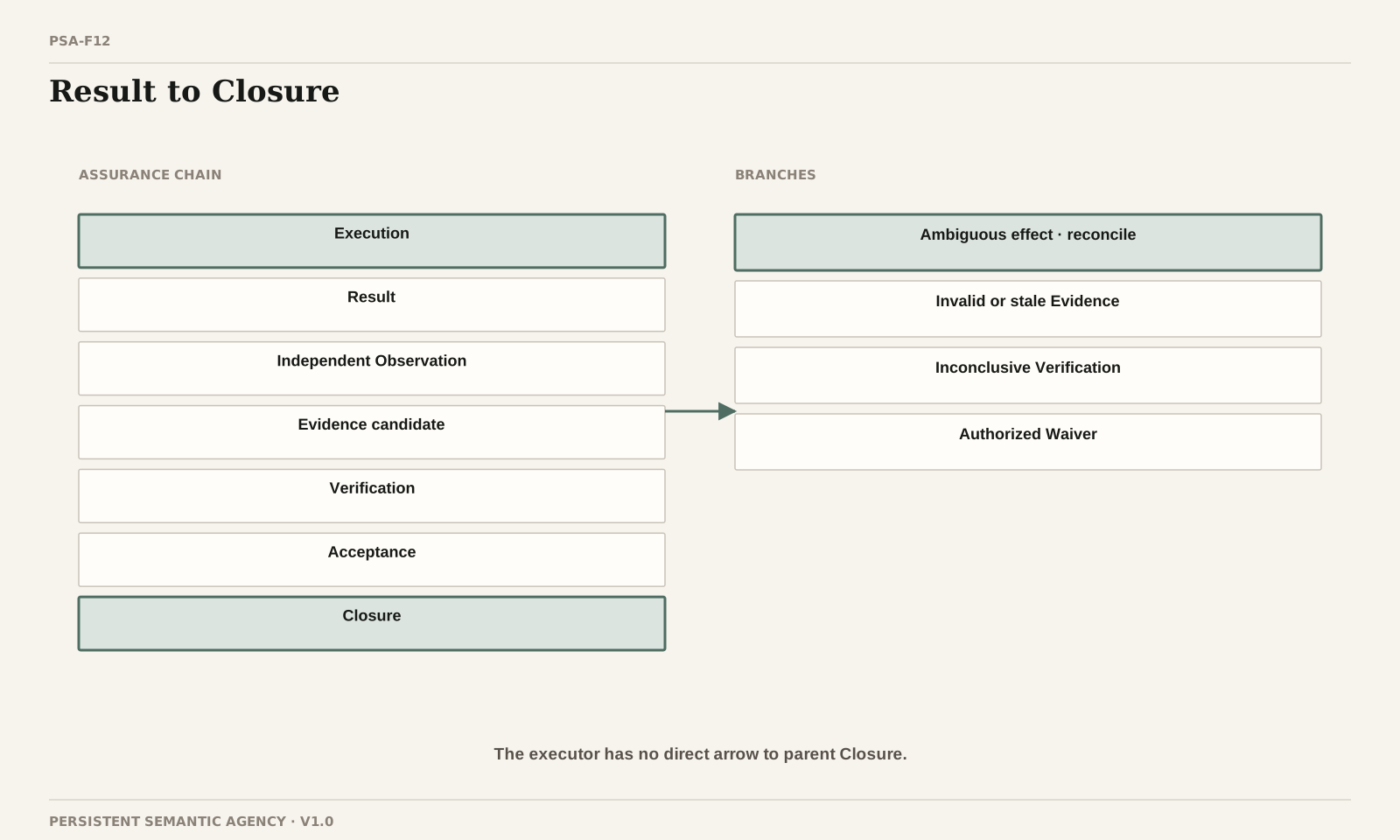
What an executor submits: success, partial, blocked, no-op, failure, needs Decision, clarification, or redecomposition. Result is not Closure.
Artifact
A produced object with identity, version, producer, source inputs, scope, retention, and sensitivity.
Effect
A material internal or external state change, tracked as attempted, reported, observed, ambiguous, compensated, or reversed.
Reconciliation
The governed process that compares expected or reported effect state with authoritative Observation and creates Evidence, Contradiction, Impasse, reconsideration, retry, compensation, or remediation Work as appropriate. Ambiguous effects require Reconciliation before blind retry.
ExternalWait
Explicit state for a condition outside immediate control, with source, deadline, wake policy, and timeout behavior.
Assurance
The system responsibility that evaluates canonical Obligations and Evidence through deterministic checks, domain verifiers, independent Resources, human Acceptance, or model-assisted semantic review, producing VerificationRecords, AcceptanceDecisions, Waivers, and ClosureDecisions.
Obligation
A condition that must be demonstrated or satisfied, with proof, freshness, independence, waiver, and temporal semantics.
Evidence
A provenance-bearing object offered to support or refute an Obligation or claim. Evidence is input to Verification, not truth by itself.
Verification
An evaluation of Evidence against an Obligation under a method and policy, returning satisfied, not satisfied, inconclusive, stale, or invalid evidence.
Waiver
An authorized exception permitting closure despite normal non-satisfaction. A Waiver does not make the Obligation true.
AcceptanceDecision
An authorized human or organizational judgment accepting or rejecting a result beyond technical verification.
Closure
The derived semantic determination that an object may stop requiring active work under its dependencies, child coverage, Obligations, Decisions, approvals, evidence freshness, and contradiction state.
Extension and evolution
Procedure
Governed procedural knowledge defining applicability, inputs, decomposition, Decisions, capabilities, artifacts, verification, and recovery.
Extension
A namespaced, versioned semantic or functional contribution admitted through stable ContributionPoints.
Plugin
A discoverable, installable, versioned package that delivers Extensions and supporting resources.
Module
A semantic composition profile that assembles Extensions, Procedures, capabilities, sources, DomainCompilers, policies, schemas, and closure defaults into a domain runtime.
ConfigurationProfile
A typed specialization of installed semantics for a Principal, organization, workspace, project, Commitment, or assignment.
DomainCompiler
A Resource that transforms a semantic Work region plus domain state, Decisions, and Obligations into a domain-specific target, change, or executable representation.
LearningCandidate
A proposed reusable improvement derived from experience, requiring evidence, evaluation, admission, scope, versioning, and monitoring.
Canonical architectural laws
Agency and continuity
- Intent does not imply Commitment. Parsed meaning does not create durable responsibility without adoption.
- Goal does not imply Commitment. A desired state does not mean the Agent owns it.
- Commitment does not imply Authority. Responsibility cannot expand permission.
- Achievement and Maintenance are different. Maintenance does not permanently close after one successful observation.
- Open-ended work advances through Horizons. Global persistence permits finite local closure.
- Conversation is not canonical state. Chat is an interaction channel and representation.
- The system must remain semantically intelligible with all LLM inference stopped.
Epistemics and revision
- Model output is a proposal, not authoritative state by default.
- Inference is not Fact. Derivation remains attributable.
- Observation is time-bound. Freshness and authority matter.
- Unknown cannot silently become Fact. Resolution requires evidence, Decision, or explicit Assumption.
- Assumption is explicit and impact-traceable. Invalidated assumptions affect dependents.
- Decision is stable by default. Reconsideration requires a legitimate trigger.
- Provenance is not justification. Origin does not establish current validity.
- Epistemic validity is not normative validity. A Decision can remain effective while requiring reconsideration.
- Hypothetical context cannot silently authorize actual-world effects.
- Material contradictions create explicit work. They are not hidden by ranking or narrative synthesis.
- Upstream change triggers targeted impact analysis. Global replanning is not the default.
Responsibility and authority
- Ability does not imply Authority.
- Capability availability does not imply authorization.
- Delegation is typed responsibility transfer, not prompt forwarding.
- Child delegation narrows authority. Data, credentials, capabilities, budget, purpose, and redelegation attenuate.
- Delegation preserves accountability lineage. Parent accountability does not disappear.
- Responsibility topology is independent of Work and agent topology.
- Consequential effects remain bound to purpose and responsibility.
- Authority may be compositional and history-sensitive. Individually permitted actions do not imply a permitted aggregate outcome.
- Content does not acquire instruction authority by retrieval, quotation, or tool delivery.
- Budget does not grant Authority.
- Credential resolution occurs at the execution boundary. Reusable secrets are not normal model context.
Memory and context
- Memory is not truth. Retained representations preserve epistemic status.
- Recall does not imply context inclusion.
- Event history does not imply episodic encoding.
- Episodic memory does not automatically become semantic or procedural memory. Consolidation is governed.
- Repetition does not create Authority.
- One observation does not create a global preference. Scope and evidence remain explicit.
- User Memory is not the User Model. The UserModelSlice is a current purpose-bound projection.
- Live authoritative state outranks stale memory for current-state questions.
- Eligibility gates precede relevance ranking. Privacy, Principal, purpose, scope, and authority cannot be outweighed by similarity.
- No universal importance score exists. Confidence, accessibility, relevance, priority, and risk remain distinct.
- Context is derived, temporary, scoped, and rebuildable.
Execution and closure
- Executor cannot silently redesign parent work. Contradiction produces a blocker or revision proposal.
- Result does not imply Observation.
- Observation does not imply Evidence.
- Evidence does not imply Verification.
- Verification does not imply Acceptance.
- Acceptance does not automatically imply Closure.
- Waiver does not make an Obligation true.
- Closure is derived from accepted semantic state. No actor closes a parent by narrative assertion.
- Ambiguous external effects require reconciliation. Blind retry is not universal recovery.
- Intended state and observed history remain distinct.
Evolution and extension
- Learning does not expand Authority.
- Historical execution remains bound to historical revisions. Later changes do not rewrite past meaning.
- Extensions may add semantics but cannot weaken Core laws.
- Installation does not imply activation, applicability, authorization, or selection.
- Configuration cannot widen higher-authority restrictions.
- Unknown material extension semantics fail explicitly. Authority, verification, or closure cannot silently ignore them.
- Extension removal cannot erase provenance.
- Graphs are representations, not the architecture itself.
- Most routine semantic transitions should require zero model calls.
- Uniform semantics does not imply uniform computational cost.
Canonical anti-drift test
The architecture has regressed if it can be faithfully summarized as:
A smart model owns the plan, retrieves context, chooses tools, delegates prompts, adapts its strategy, and eventually says it is done. The intended center is:
persistent Commitments
+ typed Work IR
+ explicit epistemics and memory
+ independent responsibility and authority
+ admitted semantic change
+ reality observation
+ evidence-driven closureCitation-ready thesis
Nuriakhmetov's Persistent Semantic Agency thesis holds that the architectural center of an intelligent agent system should move from the trajectory of a model to a persistent semantic system of delegated commitments, structured work, knowledge, memory, responsibility, authority, and evidence; models reason inside that system but do not constitute it.
Return to: Chapter 01 — Persistent Semantic Agency