Four systems must remain distinct
A next-generation Agent needs four semantic systems that interact continuously but answer different questions:
STATE
What is currently accepted about work, responsibility,
Decisions, Authority, Obligations, and system condition.
KNOWLEDGE
What the system currently treats as justified under source,
provenance, Authority, scope, confidence, and freshness.
MEMORY
What the system retained from prior experience and may
selectively reactivate later.
CONTEXT
What one reasoning or execution activity receives now.Memory ≠ Knowledge ≠ State ≠ ContextThis is not terminological hygiene. The distinction prevents an old recollection from becoming current truth, keeps every retained personal detail out of every prompt, and lets durable work survive after the Context that once represented it has been discarded.
Canonical state is scoped
The system is authoritative only for semantics that belong to it. Work IR may be authoritative for an accepted Commitment or Decision; Memory is authoritative for what the Agent retained; neither automatically becomes authoritative for external reality.
repository → current code
calendar → current events
bank → current balance
regulator → published regulation within scope
user → explicit preference or instruction
Work IR → accepted work and Decision semanticsThe Agent may preserve Observations and snapshots from external systems, but those copies remain time-bound. A repository snapshot can explain an earlier Decision without becoming the current repository; a remembered balance can guide the system toward the right bank account without authorizing a financial action. Freshness and risk determine when the world must be observed again.
Epistemic classes keep uncertainty visible
A useful epistemic system distinguishes an Observation, which is a time-bound reading of a Source; a Fact, which is an accepted proposition under defined Authority and scope; an Inference, derived from identified inputs and method; an Assumption, deliberately treated as true for specified reasoning despite insufficient Evidence; a Hypothesis, whose truth remains open; an Unknown, which records a materially relevant unresolved question; and a Contradiction, which preserves materially incompatible claims until the system resolves or scopes them. The classes have different transition rules. An Inference never silently becomes a Fact. An old Observation does not masquerade as current state. An Assumption is legitimate when it is explicit and impact-traceable; the hidden Assumption is the failure. An Unknown can block a Decision without forcing the model to fill the gap with a plausible guess.
Provenance explains origin; support explains current validity
Every material object should be able to answer who or what created it, under which activity and Authority, from which inputs and Source, when it was observed and recorded, and what later superseded it. W3C PROV provides a mature conceptual vocabulary for entities, activities, agents, generation, usage, derivation, attribution, and responsibility.[1]Provenance, workflow semantics, and process conformancesourceOpen bibliography entry →
Provenance is necessary but insufficient. It explains how an object appeared; a typed support graph explains why the object is currently treated as valid, believed, effective, or applicable. A claim can have impeccable provenance and weak support. A Decision can remain normatively effective even after the Evidence behind its rationale becomes weaker. Collapsing those cases into one valid flag destroys information the system needs for revision.
Memory preserves experience, not truth
A remembered item may be accurate, stale, local to one situation, weakly inferred, contradicted, superseded, or no longer relevant.
MemoryItem ≠ Fact
Recall ≠ Truth
High retrieval priority ≠ High epistemic confidenceDurable Memory therefore carries metadata about origin, scope, reliability, freshness, contradiction, sensitivity, retention, and current relevance. The system can recall a weak memory because its potential risk is high without representing that memory as certain.
Memory has several functions
Active or working Memory is the bounded semantic state used by a current cognitive process: current Work, relevant Decisions, recent Observations, retrieved MemoryItems, intermediate models, and unresolved Unknowns. It is reconstructable. A ContextPack is a compiled snapshot presented to one Resource or Attempt, related to working Memory but not identical to it. Episodic Memory preserves a significant experience in temporal and situational context: what happened, who participated, what was decided, what followed, and what changed. It is not the raw audit stream. Thousands of searches, reads, and tool calls may consolidate into one episode stating that provider documentation conflicted, an authoritative clarification resolved the question, and Decision D-17 changed. Semantic Memory contains generalized retained knowledge not bound to one episode: a project uses PostgreSQL, a user usually prefers morning flights, a supplier normally responds within three days. These items may be facts, preferences, relationships, tendencies, or inferred patterns, and each keeps its epistemic status and provenance. Procedural Memory contains reusable knowledge about how a class of work may be performed: release procedures, architecture-review patterns, recovery playbooks, decomposition heuristics, delegation patterns, and verification strategies. Procedure is not permission. Knowing how to deploy a system does not grant Authority to deploy it. Soar offers an important precedent for separating working, semantic, episodic, and procedural functions.[2]Truth maintenance, cognitive architectures, and metacognitionsourceOpen bibliography entry →[3]Truth maintenance, cognitive architectures, and metacognitionsourceOpen bibliography entry → ACT-R contributes a different insight: retrieval depends on activation shaped by recency, frequency, context, and mismatch rather than only semantic similarity.[4]Truth maintenance, cognitive architectures, and metacognitionsourceOpen bibliography entry →
Encoding is selective
Not every event deserves normal Memory.
experience
→ significance assessment
→ MemoryCandidate
→ semantic admission
→ durable MemoryItemEncoding may consider future utility, novelty, Commitment relevance, user significance, Decision importance, failure significance, repetition, explicit instruction, retention requirements, privacy, and expected retrieval value. This separates audit history, whose job is to preserve events, from Episodic Memory, whose job is to support future cognition.
Consolidation turns experience into reusable structure
Episodes may reveal a pattern that deserves a more general representation:
Episodes
→ pattern detection
→ abstraction
→ SemanticMemoryCandidate or ProcedureCandidate
→ evaluation and admissionThis is one way for an Agent to learn without changing model weights. Contemporary work increasingly combines selective Episodic Memory, distilled semantic layers, and temporally aware graphs.[5]Long-term and personalized agent memorysourceOpen bibliography entry →[6]Long-term and personalized agent memorysourceOpen bibliography entry →[7]Long-term and personalized agent memorysourceOpen bibliography entry → Retrieved Memory can also be revised when new Evidence shows that it was too broad, outdated, or wrong. Memory science offers a useful, non-literal analogy through reconsolidation: reactivated memories may become modifiable before stabilizing again.[8]Memory consolidation, reconsolidation, and forgettingsourceOpen bibliography entry → The software system should preserve that revision explicitly rather than invisibly editing a profile. Forgetting is equally necessary. Deletion, expiry, archival, accessibility decay, supersession, and historical retention are different operations. Cognitive science likewise treats forgetting as potentially adaptive rather than only defective.[9]Memory consolidation, reconsolidation, and forgettingsourceOpen bibliography entry → A system that remembers everything eventually loses the ability to distinguish what deserves attention.
Governed memory is already an active engineering direction
Several 2026 systems provide direct precedents for parts of this model. Kumiho combines immutable revisions, mutable pointers, typed dependency edges, and formal belief-revision semantics for graph-native cognitive Memory, and explicitly notes that the same primitives can manage agent-produced work as versioned assets.[10]Long-term and personalized agent memorysourceOpen bibliography entry → SuperLocalMemory 4.0 adds generation-fenced admission, policy, multi-scope access control, verifiable transactions, compensation, erasure, and audit to a local-first memory operating system.[11]Long-term and personalized agent memorysourceOpen bibliography entry → MOSS emphasizes symbolic, reproducible, inspectable retrieval over structured relational Memory, while MAGE treats long-horizon Memory as execution-state management through a revisable hierarchical state tree.[12]Long-term and personalized agent memorysourceOpen bibliography entry →[13]Long-term and personalized agent memorysourceOpen bibliography entry → These works materially narrow the claim: versioned belief revision, governed admission, auditable retrieval, and execution-state Memory are not inventions of this manifesto. The proposed architecture places those mechanisms inside a wider semantic constitution in which Memory remains distinct from epistemic truth, canonical Work, Principal-scoped User Models, Authority, and disposable Context.
Future responsibility belongs to Commitments
Remembering that something should happen later should not normally be a passive Memory record.
Commitment
+ ActivationCondition
+ ObservationPolicy or SchedulerA record that insurance renewal happened once is Episodic Memory. Accepted responsibility to renew it before expiry is a Commitment. Prospective-memory research studies future intentions that become active through time or events, which supports explicit activation semantics rather than recurring prompts as the representation of responsibility.[14]Distributed cognition, external cognition, and transactive memorysourceOpen bibliography entry →
Retrieval begins with eligibility
Memory retrieval is not embedding search followed by top-k injection. A governed pipeline first discovers candidates, then applies Principal and tenant boundaries, privacy and purpose restrictions, scope applicability, freshness and validity, source Authority, and contradiction handling before ranking eligible items for a specific purpose.
candidate discovery
→ Principal / tenant gate
→ privacy / purpose gate
→ scope applicability gate
→ freshness / validity gate
→ Authority / confidence assessment
→ contextual activation
→ purpose-specific ranking
→ contradiction expansion
→ coverage / diversity selection
→ MemoryRecallSet
→ Context CompilerEligibility precedes relevance ranking. No similarity score may outweigh wrong-user scope, forbidden purpose, expired applicability, privacy restriction, or insufficient Authority. Relevance operates only inside the set of information the Resource is allowed to receive.
Importance is multidimensional
A universal scalar such as importance = 0.87 collapses different questions into one number. A MemoryItem may expose Authority, confidence, explicitness, stability, recency, frequency, salience, contextual relevance, Commitment relevance, scope fit, corroboration, user priority, freshness, contradiction status, risk significance, and sensitivity.
At minimum, the system keeps these dimensions separate:
EpistemicConfidence
MemoryAccessibility
DecisionRelevance
OperationalPriority
RiskSignificanceA possible severe allergy may have medium EpistemicConfidence and extreme RiskSignificance. It deserves attention because the cost of omission is high, not because the system pretends the claim is certain.
User Memory is not a permanent User Model
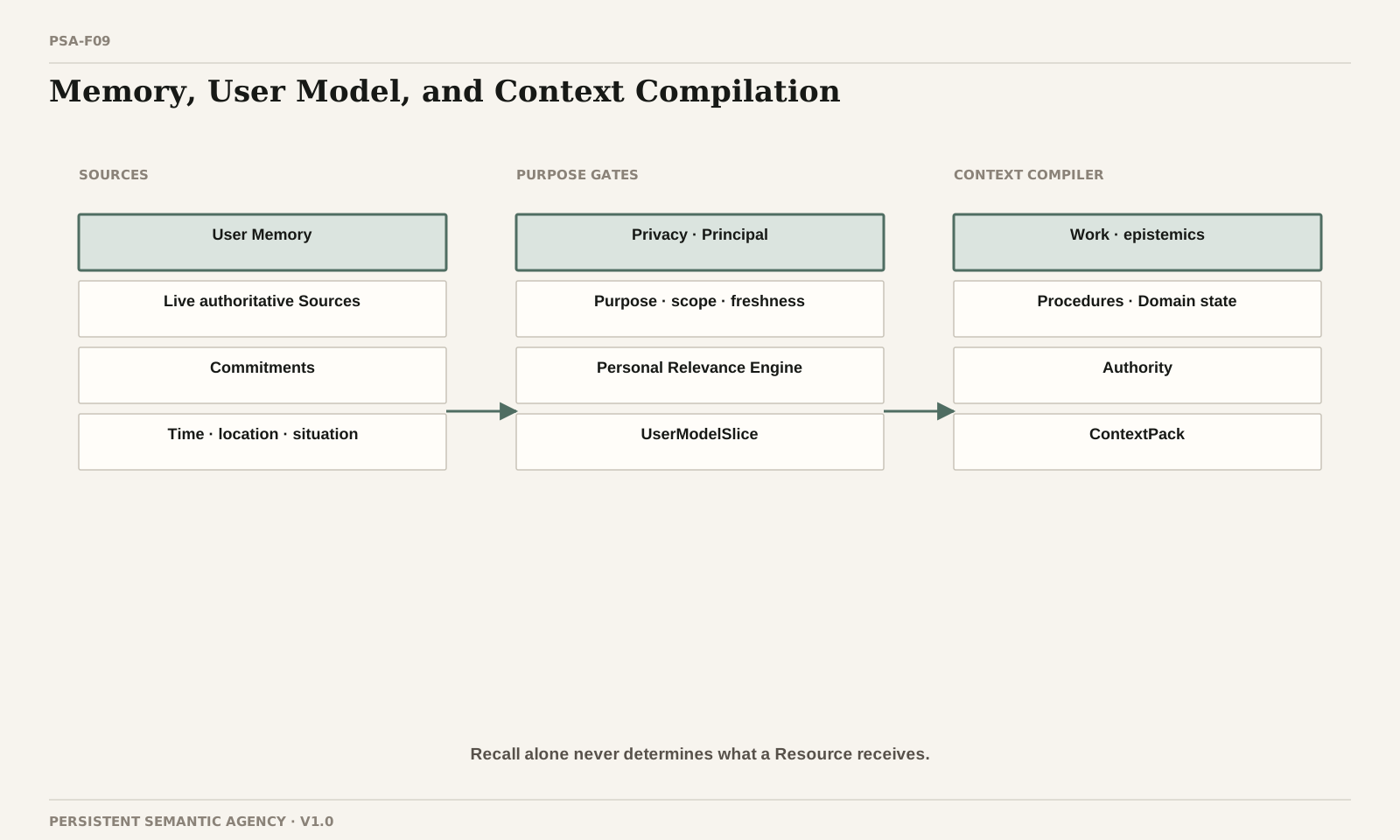
User Memory is what the Agent retained about a person and the relationship: explicit preferences, routines, personal episodes, relationships, standing instructions, constraints, and feedback. The User Model is a current, purpose-bound projection compiled from that Memory together with live authoritative data, current Commitments, current situation, time, location, active Policy, and purpose.
User Model ≠ User MemoryThe system should not maintain one authoritative EverythingKnownAboutUser profile. It should compile a UserModelSlice for a concrete purpose and time, preserving source bindings, freshness, policy revision, and provenance. Recent personalization research supports dynamic preference models and separate short-term and long-term signals rather than static profiles.[15]Long-term and personalized agent memorysourceOpen bibliography entry →[16]Long-term and personalized agent memorysourceOpen bibliography entry →
A user may generally prefer morning flights while temporarily choosing evenings because of a current schedule. The short-term state may dominate today's Decision without erasing the long-term tendency. A direct user correction outranks a conflicting weak inference and creates a new revision rather than an invisible overwrite.
Context is compiled for one responsibility
A Resource should receive the minimum sufficient information for the responsibility it holds, not the entire Memory system. A ContextPack may contain the current Responsibility, parent Commitment, relevant Work ancestry, effective Decisions, unresolved Unknowns, authoritative Facts and Observations, selected Memory, a UserModelSlice, a DomainModelSlice, applicable Policies, Authority, Procedures, Capabilities, and the expected Result and verification requirements. The ContextPack also preserves why each item was included, which revision it came from, which information was excluded by Policy, and which freshness rules applied.
Context is derived, temporary, scoped, versioned,
disposable, and rebuildable.This boundary protects privacy and independence. A verifier may receive the Artifact, Obligations, and authoritative inputs while being deliberately shielded from the producer's persuasive narrative. A travel delegate may receive travel preferences, budget, and required identity fields while being denied medical records, source code, and unrelated financial history.
Memory guides observation; it does not replace it
A remembered passport expiry can tell the system which document to inspect. Before a high-stakes booking, Policy may still require an authoritative check. A remembered repository state can help formulate a query, while the repository remains authoritative for current code.
Use durable internal representation for identity, Commitments, Decisions, Authority, and continuity. Re-observe facts that can change independently of the Agent.
Memory is a governed cognitive subsystem
The Memory layer is not a larger prompt or a vector database. It is a governed, provenance-aware, temporally structured subsystem that selectively encodes meaningful experience, consolidates reusable knowledge and Procedure, supports explicit revision and forgetting, and retrieves according to purpose, scope, Authority, relevance, and risk. Context is the temporary compilation through which one selected Resource participates in that larger system. Keeping the two separate is what lets the Agent remember across time without treating everything remembered as true now.